Islamic reflections on a dream about the stormy bridge
Perspective: islamic
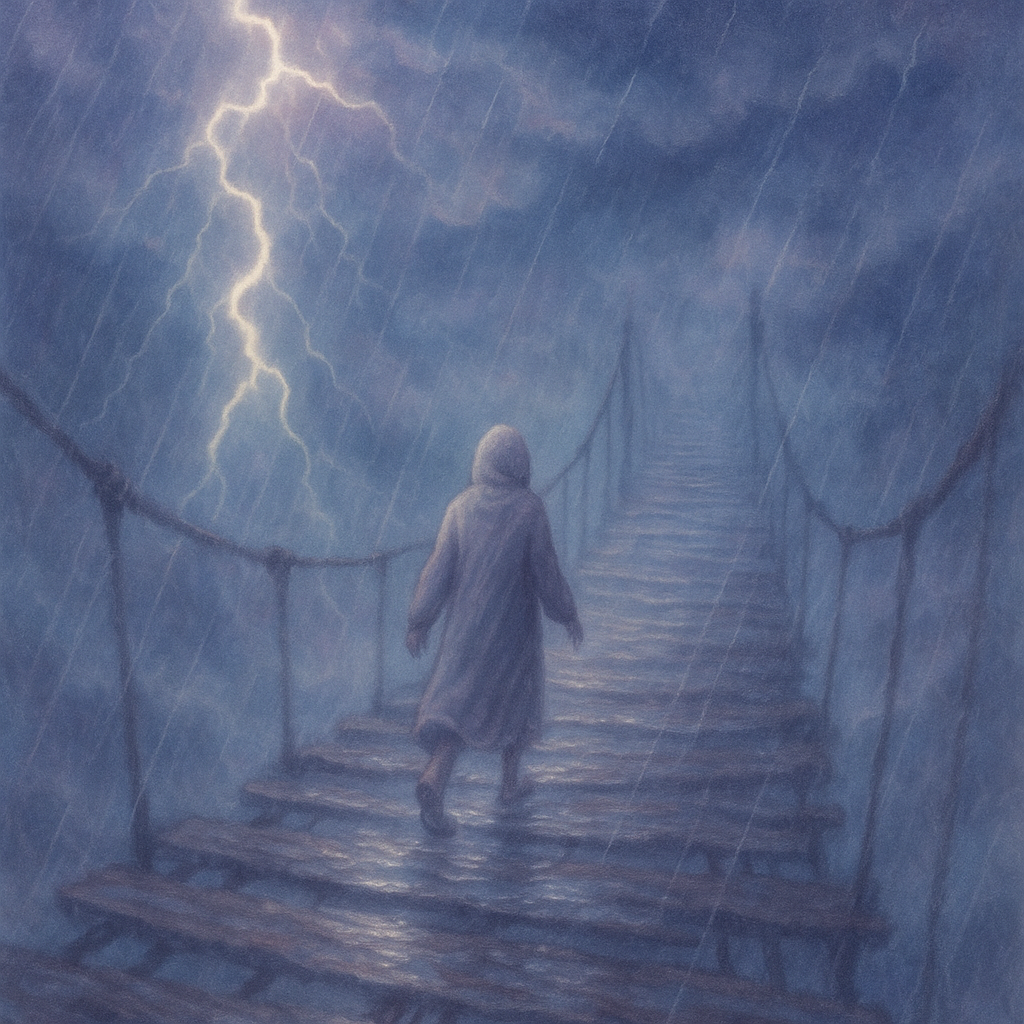
Your Dream
Last night I dreamt I was trying to cross a long, rickety bridge during a massive thunderstorm. The wood was slick with rain, and every step I took felt squishy and uncertain, like the boards might give way underneath me. Wind whipped my hair into my eyes and I kept blinking away the sting of rain. The river below was swollen and loud, churning with muddy water—I remember thinking it looked like chocolate milk, but obviously that’s not right. I was carrying my backpack, the same one I take to work, and I kept worrying about my lunch Tupperware leaking, even though that was probably the least of my concerns in a situation like that. Lightning cracked, close enough that the flash made everything go white for a second. The bridge swayed so much I grabbed the rope railing with both hands, my knuckles aching cold. I don’t remember actually getting across; I think I just kept moving forward, one step at a time, heart thumping, trying not to look down.
Your Dream, Revealed
A calm, guided space to explore what this dream may be reflecting back to you.
Dream Overview
This dream unfolds as a tense crossing over a precarious bridge in a violent thunderstorm, setting a context of vulnerability and uncertainty. The emotional tone is charged with anxiety and hyper-awareness, as the dreamer navigates unstable footing and sensory overload. The central tension emerges from the struggle to maintain progress despite mounting obstacles: slick boards, whipping wind, and the ever-present threat of falling. Key symbols—the rickety bridge, swollen river, storm, backpack, and leaking Tupperware—converge to highlight personal responsibility amid external chaos. Inner conflict is palpable in the dreamer’s fixation on minor worries (the lunch leaking) while facing genuine danger, exposing a pattern of disproportionate concern. What makes this dream distinctive is the dreamer’s unwavering focus on each step, never reaching the end, and the vivid, almost absurd observation that the muddy river looks like chocolate milk. The combination of physical discomfort and mundane worry gives this dream a rare texture: it is not just about fear, but about the peculiar burdens we carry, even in crisis. The aching knuckles gripping the rope and the persistent forward motion suggest resilience, yet also hint at exhaustion and the limits of control.
The dream opens with a clear goal: crossing the bridge. Immediately, environmental threats arise—the thunderstorm, slick wood, and swelling river—forcing the dreamer to shift from purposeful movement to cautious, survival-oriented steps. As the storm intensifies, the dreamer’s focus narrows; wind and rain become oppressive, demanding attention to each sensation and moment. The brief, almost comic focus on the lunch Tupperware interrupts the narrative, injecting a note of absurdity and highlighting the mind’s tendency to fixate on small, controllable details amid uncontrollable danger. The dream doesn’t resolve—the crossing seems endless, with the dreamer gripped by physical and emotional tension, persisting but never arriving. This unresolved progression creates a sense of being suspended in effort, where the only certainty is the next step.
Key Findings
• The dreamer’s attention to the leaking Tupperware, despite the life-threatening storm, reveals a tendency to focus on manageable problems during overwhelming stress. • The description of the muddy water as 'chocolate milk' introduces a surreal moment, suggesting the mind’s search for comfort or familiarity in chaos. • The absence of arrival—never reaching the other side—signals an ongoing internal journey rather than resolution. • Physical sensations (cold knuckles, stinging rain, squishy boards) anchor the dream in embodied anxiety, making the danger feel immediate and inescapable.
Symbol Interpretation
Rickety Bridge
The bridge represents a transitional phase in the dreamer’s life, marked by instability and doubt about whether the supports beneath them will hold.
Thunderstorm
The storm embodies external and internal turmoil, a convergence of forces that test the dreamer’s resolve.
Swollen River
The river symbolizes emotions and challenges that feel overwhelming and murky, difficult to navigate or understand.
Backpack and Tupperware
The backpack and Tupperware represent daily responsibilities and small anxieties that persist even in moments of crisis.
Rope Railing
The rope railing is a tenuous support, reflecting the dreamer’s reliance on fragile coping mechanisms.
Emotional Landscape
Initial anxiety is sparked by the daunting task of crossing a dangerous bridge, a feeling that intensifies as the dreamer becomes more aware of each precarious step. This anxiety is compounded by sensory assaults: stinging rain, whipping wind, and the visual shock of lightning, all amplifying a sense of exposure and vulnerability. The fixation on the leaking Tupperware introduces a layer of frustrated helplessness—an implicit longing for control over something, however trivial, when everything else feels out of control. A deeper fear emerges in the aching grip on the rope railing, an admission of just how close the dreamer feels to losing their hold, both literally and figuratively. Underneath all this is a quiet, persistent determination: despite discomfort and fear, the dreamer keeps moving, heart pounding, focused on survival even when the end isn’t in sight.
Psychological Insight
The dreamer’s journey across the bridge suggests a confrontation with an ongoing life transition or challenge, one that feels risky and unsupported. The mind’s shift to worrying about the lunch Tupperware, despite the immediate threat of the storm and the river, reveals an avoidance strategy—focusing on the familiar and manageable to buffer against overwhelming uncertainty. The physicality of the dream (painful knuckles, squishy steps, blinking away rain) points to a tendency to process stress somatically, carrying tension in the body rather than expressing it outwardly. The inability to see the far side of the bridge, or to remember arriving, hints at an underlying fear: that the struggle itself may never resolve, and that the effort required will remain indefinite. There is both courage and fatigue in this perseverance, and perhaps a reluctance to acknowledge just how draining it is to keep going under such strain.
Spiritual Perspective
From an Islamic perspective, the bridge in this dream can evoke the 'Sirat'—the bridge over hellfire that souls must cross in the afterlife, described as thinner than a hair and sharper than a sword. While the dream does not explicitly invoke religious imagery, the combination of vulnerability, judgment, and an endless crossing may subconsciously reference this powerful symbol of spiritual trial. The storm and the swollen river could represent the tests (fitnah) and distractions of dunya (the worldly life), while the act of holding tightly to the rope parallels holding to one’s faith (the Qur’an is sometimes called 'the rope of Allah'). The persistent worry about daily routines (the lunch) even during existential danger might reflect the challenge of maintaining spiritual focus when worldly anxieties intrude.
Integrative Insight
This dream weaves together the ordinary and the extraordinary, exposing how the weight of daily life persists even when we are tested by larger, more frightening forces. The dreamer’s tenacity in moving forward, step by uncertain step, demonstrates resilience, but also reveals the emotional toll of never feeling secure or unburdened. The most confronting realization here is how the mind clings to small, solvable problems—like the lunch—when faced with real peril, perhaps to avoid acknowledging deeper fears or fatigue. In the end, this dream is a portrait of endurance under duress, haunted by the question of what it means to truly arrive. The image of the river as 'chocolate milk'—a moment of surreal comfort in chaos—lingers as a reminder: sometimes, the search for sweetness is what keeps us moving.
Reflection Questions
- When have you found yourself obsessing over minor daily worries (like your lunch Tupperware) in moments of significant stress, and what purpose did that serve?
- How do you typically respond when you feel you are in a situation where the 'ground' beneath you is unstable or unsafe, as with the squishy boards of the bridge?
- In your spiritual journey, do you ever feel you are crossing a bridge with no visible end, and how do you balance faith and practical concerns during those times?